
Capture
Students engage in natural mathematical conversations during regular classroom activities
Our platform analyzes student discourse to uncover how children really think about mathematics—giving educators the insights they need to transform instruction and improve outcomes.

Our solution promotes mathematical discourse, revealing conceptual understanding that traditional assessments miss.

Teachers can use the insights to group students by understanding level and provides targeted instructional recommendations—without adding to your workload.

Particularly effective for multilingual learners and traditionally underserved students by capturing understanding through natural mathematical conversation.
“PowerMyLearning is helping us with the foundational math skills that are needed so that when scholars get to the third grade, they have that understanding of content.”




percentage point improvement in math achievement
of teachers report saving instructional planning time
Decades of research distilled into a practical, evidence-informed framework for elementary math learning.
Explore the Framework
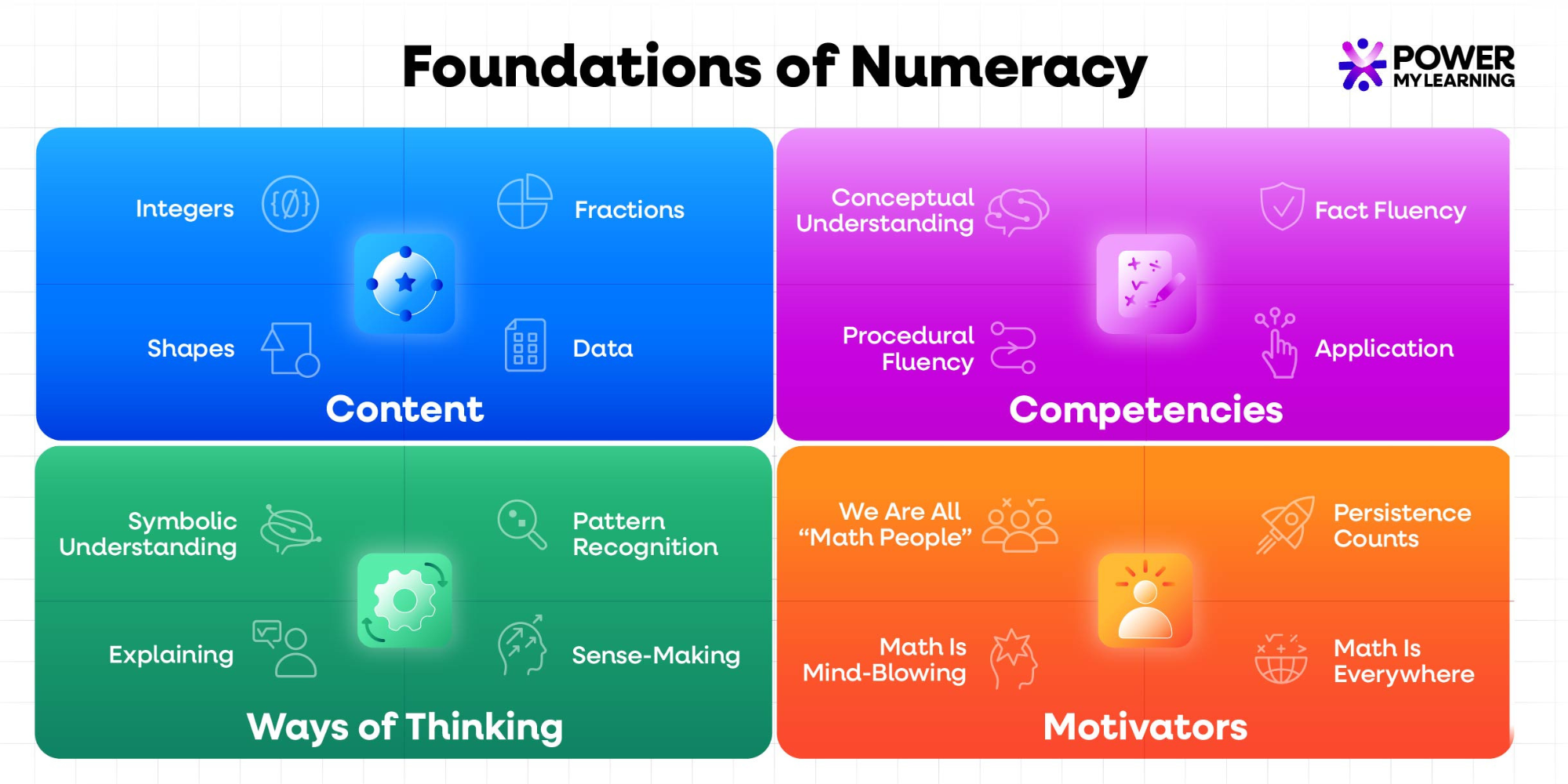
The mathematical “what” of elementary learning.

Know symbols for quantities, place value, the four operations, and estimation.

Use rational numbers to represent parts and proportional relationships.

Describe and measure the physical world using geometric and quantitative characteristics.

Represent, interpret, and communicate numerical data visually and with words.
All four are mutually reinforcing.

Demonstrate number sense; comprehend the principles behind mathematical concepts.

Use math facts with confidence and fluidity.

Execute operations accurately and efficiently.

Use math in real-world situations, such as money, time, and distance.

The cognitive approaches that power mathematical reasoning.

Represent quantities and mathematical ideas using symbols and diagrams.

Notice and use patterns to understand mathematical structure, generalize, and act accordingly.

Articulate mathematical and numerical reasoning in words.

Interpret mathematical problems, understand what is important to consider, and decide what strategies to use.

What drives learning: engagement and belief in our potential.

Believe in the innate ability of humans to understand mathematical ideas.

Have a growth mindset and know that effort leads to learning.

Appreciate the power and beauty of mathematics.

Recognize the relevance and widespread utility of math.
The mathematical “what” of elementary learning.
Know symbols for quantities, place value, the four operations, and estimation.
Use rational numbers to represent parts and proportional relationships.
Describe and measure the physical world using geometric and quantitative characteristics.
Represent, interpret, and communicate numerical data visually and with words.
All four are mutually reinforcing.
Demonstrate number sense; comprehend the principles behind mathematical concepts.
Use math facts with confidence and fluidity.
Execute operations accurately and efficiently.
Use math in real-world situations, such as money, time, and distance.
The cognitive approaches that power mathematical reasoning.
Represent quantities and mathematical ideas using symbols and diagrams.
Notice and use patterns to understand mathematical structure, generalize, and act accordingly.
Articulate mathematical and numerical reasoning in words.
Interpret mathematical problems, understand what is important to consider, and decide what strategies to use.
What drives learning: engagement and belief in our potential.
Believe in the innate ability of humans to understand mathematical ideas.
Have a growth mindset and know that effort leads to learning.
Appreciate the power and beauty of mathematics.
Recognize the relevance and widespread utility of math.
 1
1
Students engage in natural mathematical conversations during regular classroom activities
 2
2
Student discourse reveals their conceptual understanding across all building blocks of numeracy
 3
3
Teachers are empowered to use student voice to understand mathematical thinking

“PowerMyLearning provides us with resources to help our students do their math learning. [Their math programming] helps them build that tool belt and also be able to have better discourse to explain what they’re learning and how they got their answer.”

of teachers improved at using data to drive their instruction.
Join the conversation. Connect with us at leading math conferences like NCSM and NCTM to see how PowerMyLearning is helping define the future of early math learning.
Read the latest coverage in The 74 on how the Foundations of Numeracy framework is helping bring clarity and consensus to PK–5 math learning.





 Press Release
PowerMyLearning announced the launch of the Foundations of Numeracy, an evidence-informed framework developed with leading math researchers and practitioners to…
 In The News
A new article from The 74 explores the Foundations of Numeracy framework and how its four pillars can help strengthen…
 Our Impact
This study examines the impact of PowerMyLearning’s math program, which integrates the Family Playlists® math practice tool with professional learning, on…